Application
Rooftop Unit Controls
Match packaged rooftop equipment with room controls, economizer accessories, and the staging and ventilation sequence it needs.
Packaged rooftop units can use different control voltages, staging arrangements, terminal conventions, economizer interfaces, and building-control strategies. Start with the equipment model and operating sequence rather than the building type or equipment appearance.
Product options
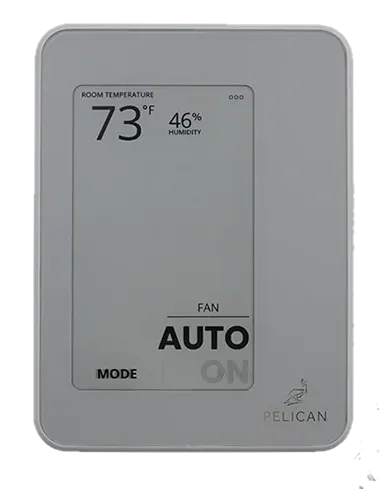
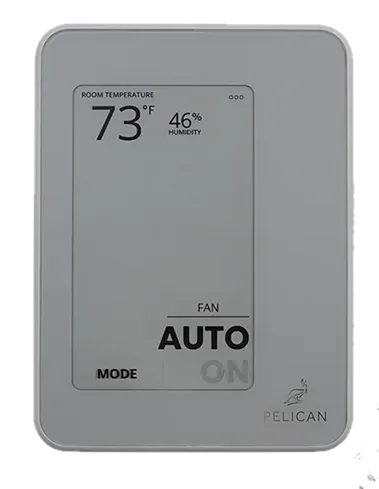
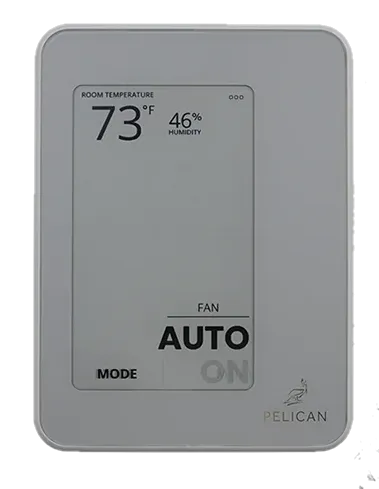
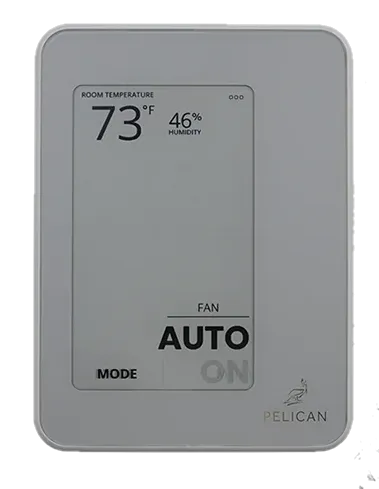
Pelican TC-series thermostats support documented conventional and heat-pump control arrangements. Choose the exact model and configuration around equipment staging and the required sensing functions. TC3 and TC4 include CO₂ sensing for supported demand-ventilation configurations; TC2 and TC4 include humidity sensing.
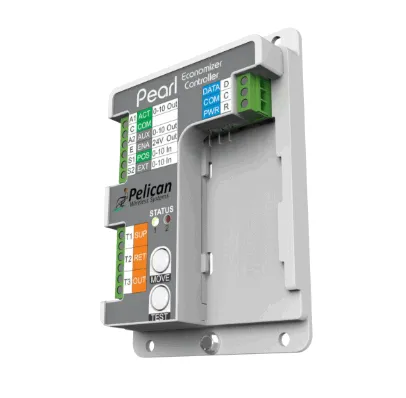
The Pelican PEARL adds economizer and configurable equipment-control functions through a wired connection to a compatible Pelican thermostat. Include the required sensors, actuator interfaces, gateway, and network in the project review. These related products are components, not a complete rooftop retrofit kit.
Before evaluating a control
Collect the rooftop unit's complete model and serial information, the existing thermostat or controller model, legible wiring photographs, and a description of the required operating sequence. Note any zone controller, equipment interface, remote sensor, or network component connected to the unit.
Confirm available power, heating and cooling stages, fan speeds, outside-air damper control, and any occupied/unoccupied inputs. Fan-speed and staging options can share controller outputs, so the exact wiring diagram matters. Proprietary communicating equipment needs a specific interface review.
See Economizer Controls for outside-air cooling, Fresh Air & Demand-Controlled Ventilation for ventilation control, and Commercial HVAC Zoning when one unit serves multiple controlled zones.
Work should be reviewed and performed by qualified personnel in accordance with the equipment documentation and applicable codes. Information on this site helps organize a selection review; it does not approve an installation design.